Artist statement
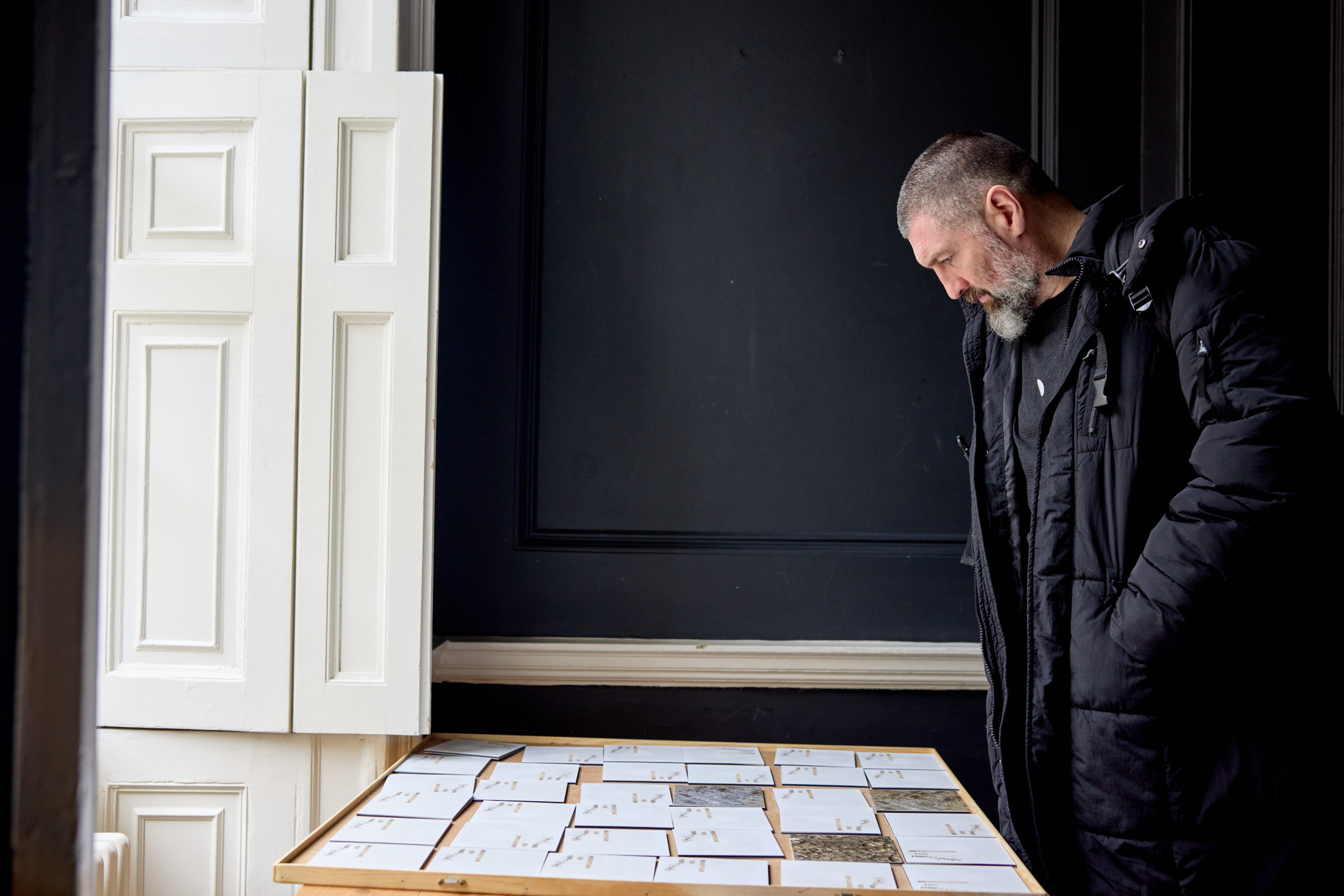
George Santayana’s famous claim that “those who cannot remember the past are condemned to repeat it” might find troubling proof in my submission; a literal reenactment of this quote that hints at the futility of remembering at all. Memorygame for Forgetfulness is a homage to Mahmoud Darwish's seminal work, “Memory for Forgetfulness”, in which the narrator reflects upon the nature of homeland, dispossession, identity and time itself during a single morning of the Lebanese Civil War. Memorygame for Forgetfulness asks similar questions of the nature of time, the act of remembering and what it means to bear distant witness to a constant war where the never-ending cycle of destruction and rebuilding confounds memory and definition.
The call for this year’s Now Play This coincided with the Hamas attacks of 7 October and the invasion of Gaza that followed. Habitual narratives, circular talking points and the usual propaganda fed a familiar news cycle that knows no memory. Indeed, seeing the images from Gaza, I wondered myself: had I not seen these pictures before? Heard the same place names, the same statistics, reactions, equivocations before? The more I tried to recall dates and specific events, the more they slipped from me into a haze of one, inescapable collage that was past, present and future all in one.
I would like to claim this is how and when I began to think of the Israeli-Palestinian conflict as a sort of perverse memory game - perpetually turning over familiar-yet-new images, straining to match them, piece them together and arrive hopefully at some sort of whole. The more embarrassing truth is that I’ve been working on this stupidly simple game for more than ten years, reluctantly accepting it as a perpetual work in progress. But then NPT’s theme of liminality brought to mind Darwish’s work, swimming between times, memories and existences, zooming in to the quotidian and in the next breath pulling back to embrace the universal. I suddenly understood the limbo of my game was a necessary feature of the conflict - a theme also running through Darwish’s work - and the title became obvious.
The format borrows the well-known trope of a memory game where image pairs are laid face-down in a grid and players are invited to reveal cards in turn and attempt to match pairs when they arise. While most memory games are targeted at children with simple, contrasting pictures, Memorygame for Forgetfulness uses various aerial photos of Gaza’s destruction over the past ten years - a catalogue of images that is unerringly, even tediously, similar.
I initially experimented with a variety of image sets, from harrowing on-the-ground photo journalism to street-level destruction, before arriving finally at aerial photography. While the human stories provoked the strongest reactions during playtesting, I felt ultimately that they risked being exploitative and too close to the news cycle imagery that I was trying to create a thoughtful counterpoint to. Ultimately, the reassuring distance afforded by satellite images was favoured for its ambiguity - not just between the images themselves but in a P.O.V. disconcertingly similar to that of a drone or fighter pilot.
Developing this game presented unique challenges; building a suitable library of images was its own frustrating and emotionally draining journey, eerily echoing the game itself; how do I identify when a photo was taken? Does it even matter? Is that one too similar, too different? Is this too frivolous for the subject at hand? Games have a cultural and emotional connection to fun and there's a fine line to tread when employing them as a lens to view something tragic, but play is a serious endeavour too. As an interactive medium, games are ideally suited to provoke active engagement with ideas, creating a sandpit of safe experimentation, in which understanding and empathy are more likely to flow unhindered.
Similar to the experience of preparing the game, in play too, the multitude of human tragedies gives way to an emotionless administrative task. The game takes over; the rules prevent the player from seeing too much and traumatic narratives dissolve. In this manner, the process of becoming desensitised to destruction at scale within the space of one game is analogous to the speed with which we forget the impact of those wars we are instrumental in supporting and funding - specifically the Israel-Palestine conflict: it all blurs together, no lessons are learned, it all looks the same, with every side locked into a repetitive act of wilful amnesia.
The game is intended primarily for those who are removed from the conflict, asking them to reflect upon how perspective is both a privilege and a valuable tool, but one which comes with a certain dehumanisation and blindness to detail. Players are invited to analyse their own perspective and what is both lost and gained through that. An implicit call to action is hopefully contained for us to be more active consumers of similar, future images, vigilantly searching for common themes, resisting the urge to shrug at "yet another" escalation of violence and actively seek out the vital human stories that litter this and other conflicts we are distanced-yet-connected to.
While your own experience of Memorygame for Forgetfulness may encompass more (or less), as players swoop in and out of the piece, switching from mundane tasks to the overwhelming significance of the images - from micro to macro and the many liminal spaces in between - I hope at least that the resulting emotional disorientation will be one of the lasting memories from this year’s festival.